Interpretable Context Methodology is a way of running AI off plain folders and text files instead of code. You put a map file at the top of your project saying where everything lives, a small instruction file inside each folder saying how to work on that one thing, and numbers on the folders that happen in an order. Then 1 AI agent walks it, pulling out only the folder it needs for the step it is on. No framework, no team of bots, no subscription. The method is Jake Van Clief and David McDermott's. I am the guy who had to translate it into something he could actually use, and I put the translation on video.
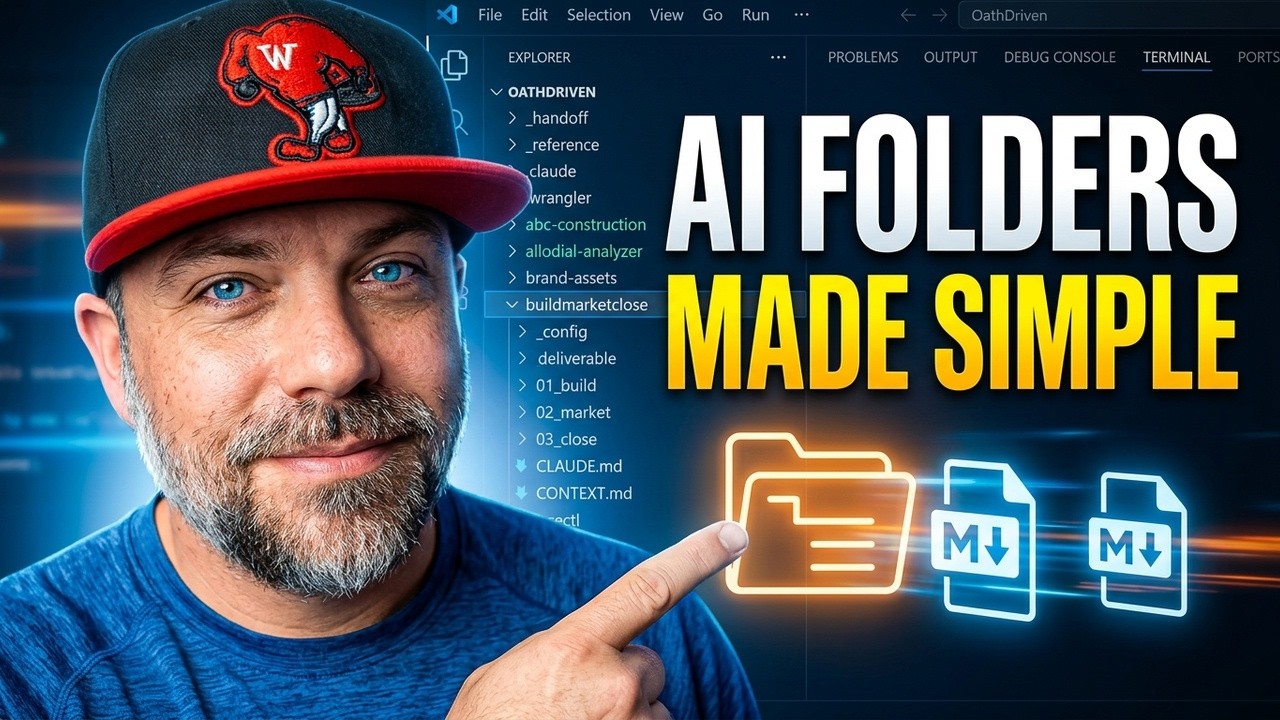
What Is Interpretable Context Methodology?
It is a methodology published in March 2026 by Jake Van Clief and David McDermott, and the formal version is a paper called Folder Structure as Agentic Architecture. The protocol inside it is the Model Workspace Protocol. It is open source under the MIT license and the thing is on GitHub if you want to read it yourself.
The paper's own summary: numbered folders represent stages, plain markdown files carry the prompts and context that tell a single agent what role to play at each step, and local scripts handle the mechanical work that does not need AI at all. 1 agent reading the right files at the right moment does the work that would otherwise take a multi-agent framework.
Every word of that is true. I read it 4 times and still could not do a single thing with it.
Here is what I got when I asked AI to explain it to me instead.
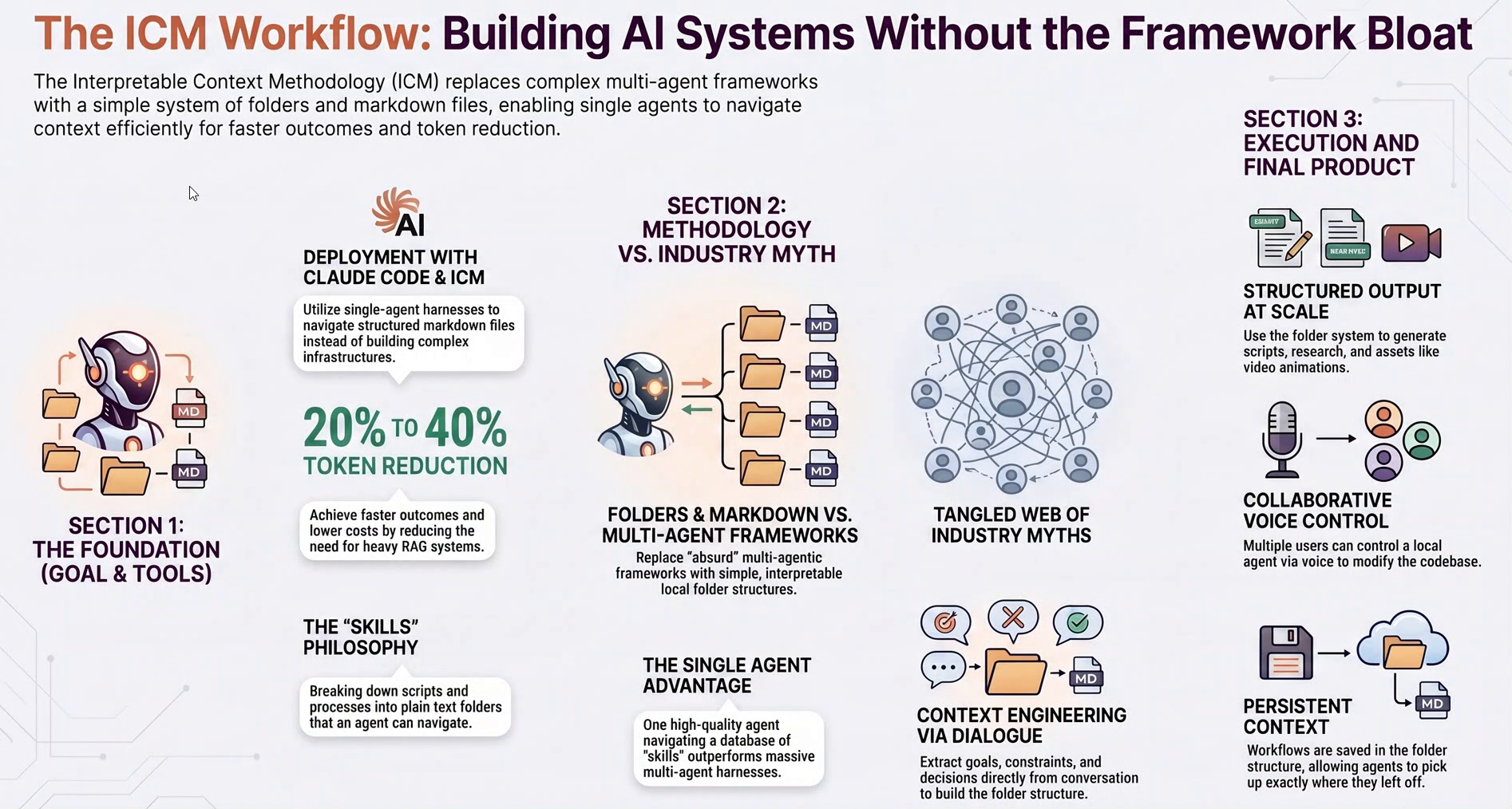
There is a robot with glowing eyes. There is something called a Tangled Web of Industry Myths. There are 3 numbered sections. When I finished reading it I knew exactly as much as when I started.
So the rest of this is the other version. Not better than theirs, just further back down the road. I give the credit properly at 1:05 and I will say it here too: none of the thinking is mine. I cannot write a line of code. I am a sales closer and a Marine who has been running at this for about 50 days, and in Jake's room I am comfortably the dumbest guy in there.
Why Does AI Forget What You Told It?
Because it has a desk, and the desk runs out of room.
When you ask an AI something, it does not magically know anything about you or your company. It reads. It pulls things in front of it and looks at them. Your document, that other document, the thread from yesterday, the 4 files it figured might be relevant. And there is a hard limit on how much fits.
When something falls off the edge, it does not tell you. It does not say "hey, I lost your brand guide." It quietly answers you without it, with total confidence. That is why the same prompt gives you gold on Monday and garbage on Tuesday. Nothing was wrong with you. Something fell off the desk. That is the limit, at 5:20.
The proper name for the desk is the context window. The stuff on it is called context. So the next time somebody drops "context engineering" on you and it lands like a 6 syllable way to make you feel stupid, all it means is deciding what goes on the desk. That is the field. Named at 5:55.
ICM is one answer to that limit: clear the desk, tape down a map, and pull out 1 folder at a time.
What Does The ICM Folder Structure Look Like?
3 things, and you already know how to make all of them.
- The card taped to the desk. A file called
CLAUDE.mdat the top of your project. It gets read every session before anything else. Claude Code reads it on its own, and Cowork needs 1 line to find it. It is not the work. It is a map: where is the brand voice, where is the pricing, what should never be touched. Anthropic documents this file directly, so it is not a convention somebody invented on Twitter. - A file inside each folder. A
CONTEXT.md. Same idea, smaller scope. The card says where things are. TheCONTEXT.mdsays how to work on that one thing once you get there. It only loads when you are actually in that folder, so the rest of the time it costs you nothing. - Numbers on the folders.
01_,02_,03_. Research before you write, write before you edit. If the agent can only hold 1 at a time, they have to go in an order.
The real filenames start at 10:25. You will see others in the wild. IDENTITY.md turns up in some setups. Ignore those for now, because those 2 files will carry you further than you would think.
There is a 4th piece that is easy to skim past and is the reason I trust the thing. Before that folder goes back in the drawer, you look at it. Not because the AI is stupid. Because it is your drawer and you are the one who knows if it is right.
That is the difference between this and turning a swarm of bots loose for 20 minutes and getting handed something you now have to audit backwards. Here, every step leaves a file on the desk you can open, read, and fix before anything moves forward. If you have been nervous about handing real work to AI, that is the part that should relax you. You never give up the wheel. You are just not typing as much. At 7:50.
Why Not Just Build A Team Of AI Agents?
Because that is 6 desks instead of 1, and none of them can see each other.
This is the road the industry went down first, and it is the road I went down without anyone selling it to me. I had 1 AI doing my copy. Another writing code. Another doing research. Each one made sense on its own. They were all good at their jobs.
And I was the messenger boy between my own robots.
Walking back and forth all day, copying what this one said, carrying it to that one, explaining the situation again from scratch because that one had no idea what just happened. Then carrying the answer back. Every time. I had automated the work and made myself the intern, and I thought that was the job. At 4:05.
That is exactly why so many multi-agent setups look unbelievable in a demo and fall apart the second you point them at real work. Every desk has to be told everything from scratch, so your actual job becomes managing handoffs between things that are blind to each other, which is why a multi agent workflow quietly turns the owner into the errand boy about 3 weeks in.
The AI was not broken. My structure was. At 9:48.
You do not need 6 desks. You need 1 desk that does not fill up. That is the argument the paper makes in academic language and it is the argument my week made in plain language, and they are the same argument.
Does Interpretable Context Methodology Actually Save Tokens?
Yes, but I am not going to repeat a number I did not measure.
You will see 20%, 40%, and 80% thrown around. The infographic up top says 20 to 40 and cites nothing. I have no idea where any of those came from. What the paper itself claims is a range, not a percentage: a stage typically loads 2,000 to 8,000 tokens of context, against 30,000 to 50,000 for the monolithic approach where everything gets read every time.
Here is a number from my own machine instead.
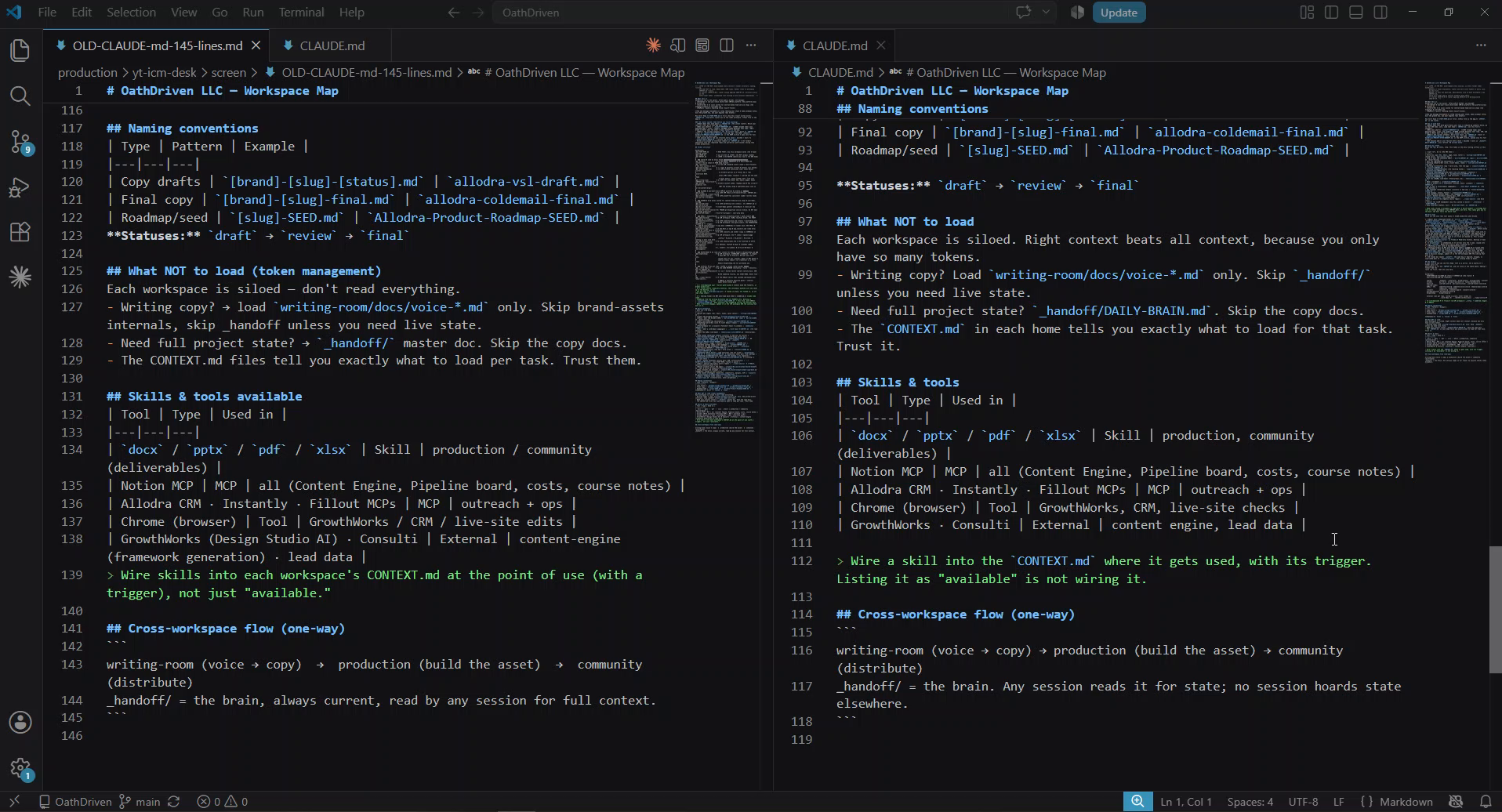
That is the same file, before and after. 146 lines on the left, 119 on the right. It gets loaded on every request I will ever make, in every folder, forever. So 27 lines is a small number that gets multiplied by everything I do for the rest of the year.
And the map is the cheap part. The real saving is every workspace that never comes out of the drawer at all on a given job. The honest version of the numbers, at 13:50.
What Did I Get Wrong With It?
I had the same facts written down in 2 places, and it quietly poisoned my results for about a week.
I had been using the method since early July. It got better almost immediately, and I could tell it was not better all the way, and I could not name why. The reason: my map file carried a 55 line ASCII picture of my folder tree. It felt organized. It felt thorough. That exact same information also lived in a second file. When I added a new folder I updated one of them and forgot the other.
So the AI was reading 2 files that disagreed. It does not throw an error. It does not stop and ask which one is right. It picks one and answers you with total confidence, which is the same failure mode as the desk overflowing, just with a different cause.
One fact, one home. The second you write the same thing in 2 places, you have built yourself a slow leak. At 14:45.
That is also the honest state of my own experience with this. About 3 weeks in, still breaking things, still the slowest guy in the room. I am not ahead of you. I am just close enough to the start to still remember what the first mile looked like.
How Do You Start With ICM On Monday?
Open the folder you already work in. The real one, where your stuff already lives. Make 1 text file in it called CLAUDE.md and write 3 things:
- What this folder is for, in 1 sentence.
- Where things live, as a short list.
- What you never want touched.
That is a context layer. That is the thing everybody is making infographics about. Takes about 10 minutes and costs nothing. Now when you point an AI at that folder it starts by reading your card instead of guessing, and that difference is not subtle. The live build, at 15:05.
If you would rather not start from an empty file, I put this on its own site and give it away: the free ICM folder system starter kit is the map, the desk file and the folders, with a real project already half built inside so you learn it on actual work instead of on a pretend folder.
Then only add the next piece when something annoys you. You keep re-explaining your brand voice? Make a file for the brand voice and put 1 line on the card saying where it is. Same for pricing. That is how this actually gets built, not by designing a system on day 1.
Every question people ask me about this now lives in one place: every question about the ICM folder system, answered. What a CLAUDE.md file is, how long it should be, where the folders go, why an AI forgets halfway through a job.
You do not need to be technical for a second of it. If you have ever organized a shared drive so your coworkers could find things, you have already done the hard part. You just did it for people instead of for a machine. I wrote up the full folder system I ran 3 businesses on if you want the version with my real files in it, and the funnel I built on it start to finish if you want to watch it produce something.
Why This Matters If You Want To Own Your Stack
Because your operating knowledge is the one asset nobody sells you a subscription for, and it is the one most businesses have never actually held.
We say it about software all the time: rent your CRM and your funnels, automations, and contacts live on a landlord's land, so the day you stop paying it all vanishes. Scattering your knowledge across 9 apps does the same thing quietly. It lives everywhere and nowhere, which is why buying AI seats changes nothing. There is no structure for the AI to stand on.
Interpretable Context Methodology fixes that with plain files you hold. Not a platform, not a vendor, not a seat. Folders on your own machine, in your own repo, readable by any model that exists next year. That is the knowledge layer, taken to allodial title the same way you take the software layer. Start with the structure, because it is free and takes an afternoon.
And if you want to see a finished ICM build working in the wild, I entered Jake's weekly competition with one: a deal coroner that analyzes lost sales calls with AI and names the stage where the deal actually died. Same folder shape, 5 files, tested by killing 2 deals on purpose. And my YouTube channel itself runs on the same shape now: an AI video production workflow where 9 numbered stages read each other's files, research all the way to blog post. The biggest receipt yet: 1 prompt ran a full AI content automation day, rebranding 8 videos with 0 reshoots while I was at Walmart.
It holds up against live client accounts too. The same folder shape is what I set up before I connect GHL to Claude, because that connection is scoped to 1 client at a time and something other than your memory has to know which is which.
Where To Go Next
3 doors, all free to walk through.
The room where I learned this is Jake's, and it is where the methodology actually lives. Start free in Clief Notes. Straight up, that is an affiliate link. There is a free tier so it costs you nothing to go look, and I pay for the top one myself and would point you there either way. Now you know, so you can decide.
The folder system itself lives at filesnfolders.com. That is where I teach this one thing properly, to people running a business rather than to developers. The starter kit is free, there is no card, and the blog there answers everything I get asked.
My room is for the other half of the problem. Structure is what lets you build the thing. Selling it is a separate skill and nobody teaches it to builders. Build Market Close is free too, and that is what we work on in there.
And every skill I use inside this folder system is public on GitHub, free, no opt-in.
Now go be dangerous.
Always got your back.
RyMac.