You build a sales funnel with AI by giving 1 agent a folder of plain text files that describe the job, then letting it write the page, wire the form into a CRM you own, and draft the follow-up emails. No funnel software, no multi-agent framework, no subscription at the end of it. I did the whole thing in a single session with the recording running, domain to live page to leads landing in my own database. Watch it here, then read the short version below.
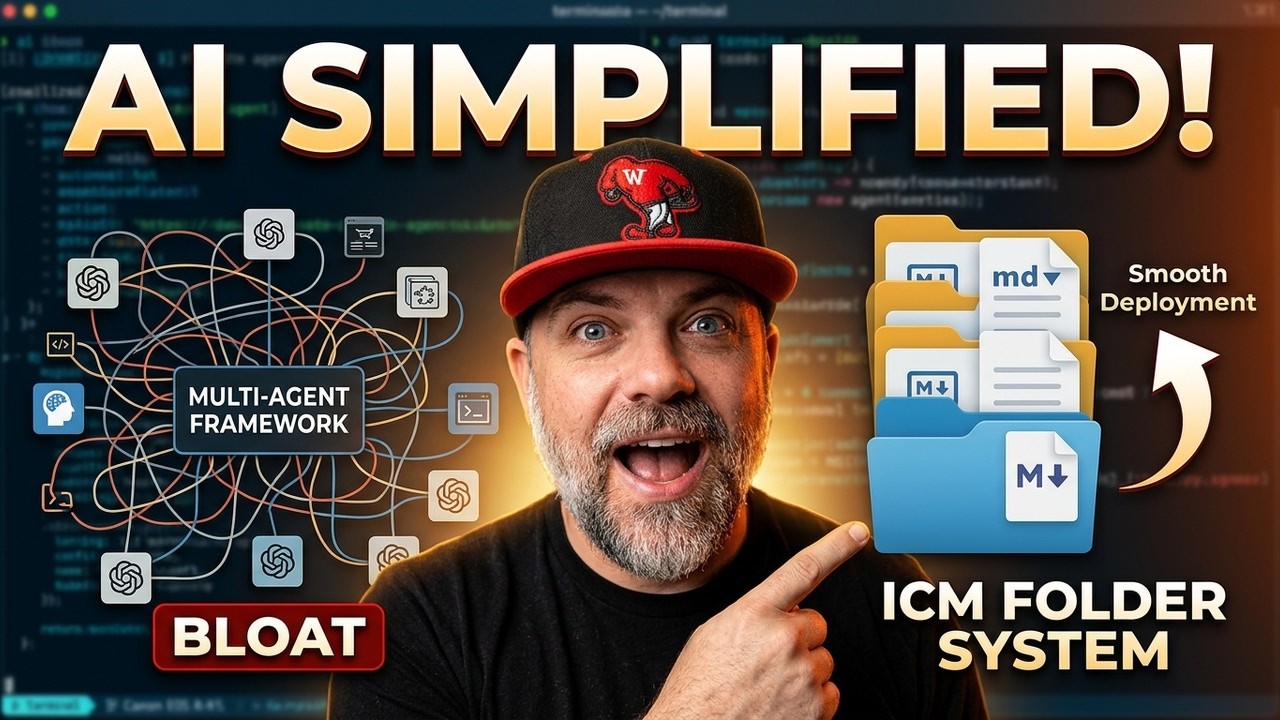
What Does It Mean To Build A Sales Funnel With AI?
There are 2 very different things hiding under that phrase, and only 1 of them leaves you owning anything.
The first is what every result on page 1 sells you: an AI funnel builder inside a platform. You type a prompt, the platform generates pages, and the funnel lives on the platform's servers under the platform's account. That is not building. That is decorating a rental. ClickFunnels runs $97 to $297 a month and the higher tiers meter your contacts, so the bill climbs as the list you built grows. Stop paying and the funnel is gone, along with the leads in it.
The second is what I did on camera: the AI writes actual files, the files go into your GitHub, the page deploys to your own hosting, the form posts into your own CRM, and the emails send from your own domain. Same 30 minutes of prompting. Completely different ending. One of them you rent forever, the other one you keep.
Do You Need Multi-Agent AI To Build A Funnel?
No, and this is the part the internet has backwards. The advice everywhere is to wire up a research agent, a copywriter agent, a developer agent, and an orchestrator to babysit all of them. I tried it. I spent my days as a messenger boy, telling agent B what agent C already knew, burning tokens re-explaining my own business.
What replaced it is Jake Van Clief's ICM method, interpretable context methodology, and there is a real paper behind it. You skip the framework and put the context in folders and markdown files instead. Markdown is just a text file. That is genuinely the whole trick, and the reason it beats orchestration code is that each stage loads only the context that stage needs, so the model never wades through a swamp of irrelevant history. I explain why I killed my own multi-agent setup at 6:00.
Then 1 agent walks the folders. It reads a map file first, gets routed to the right workspace, and does the research job, then the copy job, then the build job, in sequence, holding everything it learned the entire time. In this build it did fan out 3 short research sprints to mine real complaints out of forums, which is the correct use of a sub-agent: a cheap parallel errand, not a permanent department. The full folder structure walkthrough starts at 8:59.
The reason it works is boring and important. Your files are the memory. Nothing gets re-taught at the start of a session because nothing was ever forgotten. If you want the deeper version of this idea, I broke down how to organize a business so AI can run it after 41 days of living in it.
What Are The 4 Parts Of A Funnel You Can Own?
A funnel is 4 jobs. Platforms bundle them and charge you rent for the bundle. Unbundled, each one has a version you hold title to:
- The page. Real HTML in your GitHub repo, deployed to Vercel. It is your code. You can move it anywhere in an afternoon.
- The database. The form posts to a CRM you own. Mine is Allodra, the platform I built after I got tired of renting. In the video I create the sub-account, build the form, and wire the capture live starting at 56:15.
- The sending. Email goes out through your own verified domain, so the list is a relationship with you, not a record in someone's tenant table.
- The copy. Written into markdown files that sit in your folder. This is the one everybody skips, and it is why most people rewrite their funnel from scratch every time they change tools.
The infrastructure underneath all 4 is the part the platforms need you to not look at. Google Cloud, GitHub, and Vercel free tiers are so large a small business will never cross them. You are not paying $297 a month for servers. You are paying it for permission.
What Does An AI-Built Sales Funnel Cost To Run?
Here is my actual Vercel bill, and it is not hosting 1 funnel. It is hosting my entire portfolio.
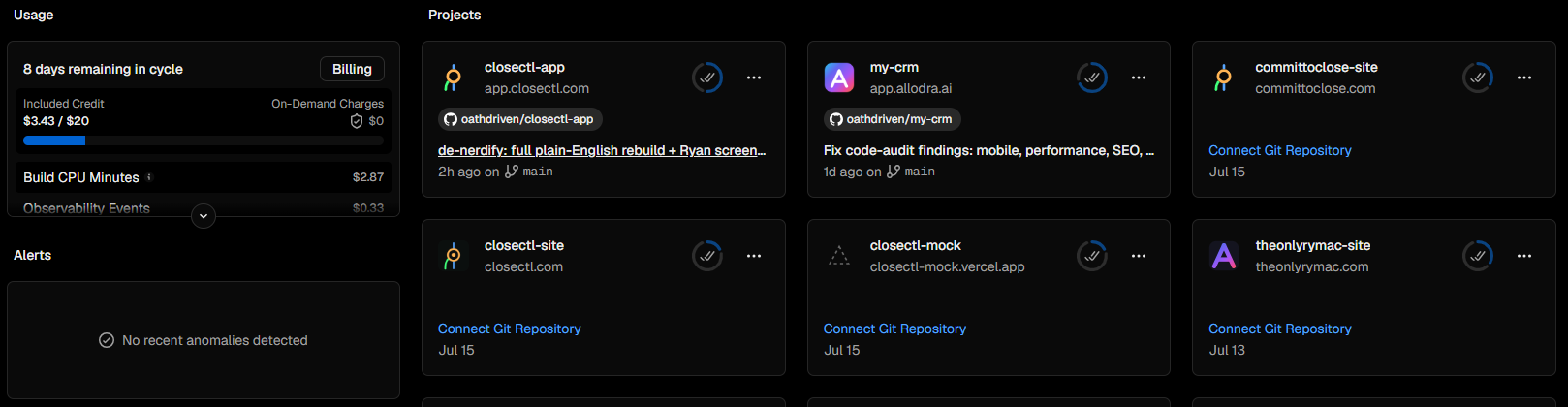
$3.43 against a $20 credit, 8 days left in the cycle, 12 live projects. That includes the CRM, 2 marketing sites, this blog, and the funnel I built in the video. Most of that $3.43 is build CPU minutes, which I only spend because I am shipping constantly. If you launch 1 page and leave it, you sit on the free tier.
The database is Firestore on the Google Cloud free tier. Email runs through Resend, which has a free tier that covers a normal list. I pay them $20 a month only because I send from several brands. The AI itself is the real line item, and it is the one you can turn off the moment you stop building.
Compare that honestly against $97 to $297 a month, every month, forever, on a funnel you never take with you. If you have been shopping tools, the pattern repeats: ClickFunnels and Kartra both meter you as you grow. Different landlords, same lease.
What Did The AI Get Wrong?
The page. Not the code, the positioning, and I want to be straight about that because the "AI builds your funnel in 30 seconds" pitch is a lie by omission.
The first headline it wrote was clean and completely wrong for the job. It had message-matched the page to that one video, which is right for a single campaign and wrong for a permanent front door. Then its next pass gave me "builders can't sell, closers can't build" as a headline, which is punchy and insults an entire category of people. On camera I told it exactly that: name who the page is for, do not call out a whole genre. The headline rework runs from 26:59 and it is the least glamorous, most useful stretch of the video.
It also pushed back on me correctly. When I wanted to claim a 7-day outcome, it flagged that 7 days is a promise about the reader's speed, which I do not control, and a skeptical buyer will price that in. The published line ends up being about what I hand over instead. That is a better claim because it is checkable.
The AI does the labor. You still have to be the marketer. Anyone selling you the other version is selling you a subscription.
Why The Email Sequence Matters More Than The Page
The page captures. The sequence is the only reason anyone is still there in 3 weeks, and it is the half that funnel software encourages you to skip because it has no button for it.
2 rules I gave the AI out loud, and they are yours:
- Email 1 is always "here's your stuff." Not a welcome, not a pitch. They gave you an email address for a specific thing, so the thing arrives first. That decision at 1:09:00 reshaped the whole sequence.
- No naked emails. Every send has 1 thing to click and delivers on a promise the last one made.
There is a third one that sounds like a design nitpick and is not. A subscriber told me my emails were forcing a white background on his dark phone. Half your list reads at 6am in the dark, and if opening your email hurts their eyes, they stop opening your email. I told the AI to honor the reader's device theme, it fixed the shell, and he wrote back: "it's been a really long time since I read emails in the way you've got me to read them. I actually look forward to them now."
That message is the whole argument. It came from an email template detail, not from a funnel feature. No platform was ever going to catch that for you.
The finished sequence is 10 emails over the first 21 days, written into markdown in the same folder as everything else. Which means next time I do not rewrite it. I point the agent at the folder.
If you want to see where the rent math lands for your own stack, run your numbers in the analyzer. And if you would rather build the CRM half yourself, I wrote up how I built mine with AI without knowing how to code. Every skill I used in this build is public on GitHub, free, no opt-in.
Now go be dangerous.
Always got your back.
RyMac.