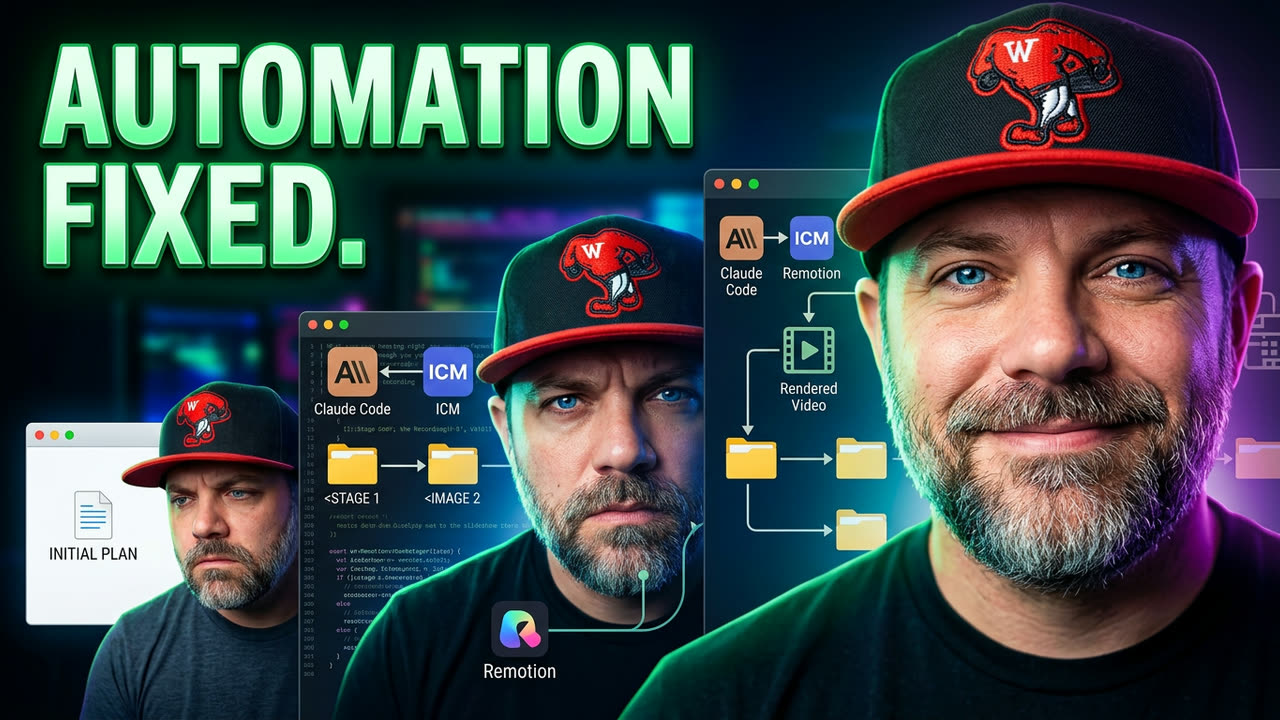
An AI video production workflow is a fixed sequence of stages where the AI does the building and you only show up for judgment calls. Mine has 9 stages, needs about 40 minutes of my time per video, and the finished video renders for about 6 cents. I just published a video walking every stage of it, and the video itself was built by the workflow it teaches.
Most of what ranks for this topic is agency blogs quoting $10,000 to $30,000 per AI-assisted video and 2 to 3 week timelines. Lemonlight's workflow guide is honest about those numbers, and for agency work they're real. But if you're an owner making your own content, you don't need an agency workflow. You need a production line you own.
What Does An AI Video Production Workflow Actually Look Like?
Mine is 9 stages, and every stage produces 1 file that the next stage reads:
- Research. Find what people already search for. Leave with a keyword, a title, and a hook. That trio gets locked and never changes. (2:34 in the video)
- Gameplan. 1 file holding the whole idea: the story, the proof on hand, the traps to avoid.
- Script. The AI writes it from the gameplan, in my voice. I approve or redline. (3:52)
- Spec. What's on screen for every single line. My 2nd approval.
- Reader. The approved script becomes a slideshow I perform, pauses marked in seconds.
- Record. The only stage that needs my body. I record, drop the file, walk away.
- Render. Voice plus slides become the finished video. About 30 seconds, about 6 cents. (6:16)
- Package. The video becomes a free download my community can run.
- Blog. The live link gets a search-matched post. You're reading stage 9 right now.
The engine underneath is Claude Code writing everything and Remotion turning slides into finished video. I broke down that pairing in how I build every video with Claude Code and Remotion. The steering system is Jake Van Clief's ICM folder system, which I explained in plain English in what interpretable context methodology actually is.
Why Order Beats Tools
I ran this exact workflow backwards first, and it nearly made me quit.
Script with no research. Approved my own words on vibes. Built the finished video FIRST, then tried to squeeze my voice into it. Skipped the spec because I didn't know what it was for. The result: a 10 minute video ate an entire day, because every small fix meant rebuilding the whole thing. (The disaster starts at 0:48.)
The tools never changed. The order did. Each stage exists to make the next stage cheap: research makes the gameplan honest, the gameplan makes the script accurate, the script makes the spec exact. When the whole thing finally clicked at the ICM video, I rebuilt the line in the right order and haven't lost a day to a rebuild since.
If your business knowledge isn't organized in a way an AI can walk, start there first: organize your business for AI is the same principle pointed at everything else you do.
Where Do Humans Fit In An AI Video Workflow?
At exactly 2 gates and 1 microphone.
Gate 1 is the script. I read it and approve it or redline it. 9 out of 10 come out usable as delivered. On my first Remotion video, I added exactly 2 words.
Gate 2 is the spec. Everything the viewer will see, approved before anything gets built.
The rule that makes the gates work: a failed approval costs nothing, a failed build costs the whole afternoon. Reading a script takes 10 minutes. Rebuilding a video takes a day. Put your cheap human judgment right before the expensive machine step, and the machine never builds the wrong thing fast.
Past the gates, my whole job is 3 things: pick the topic, approve the words, and talk. No editing program ever opens on my machine.
What Does It Cost To Run?
Here's the render stage receipt, straight from the video:
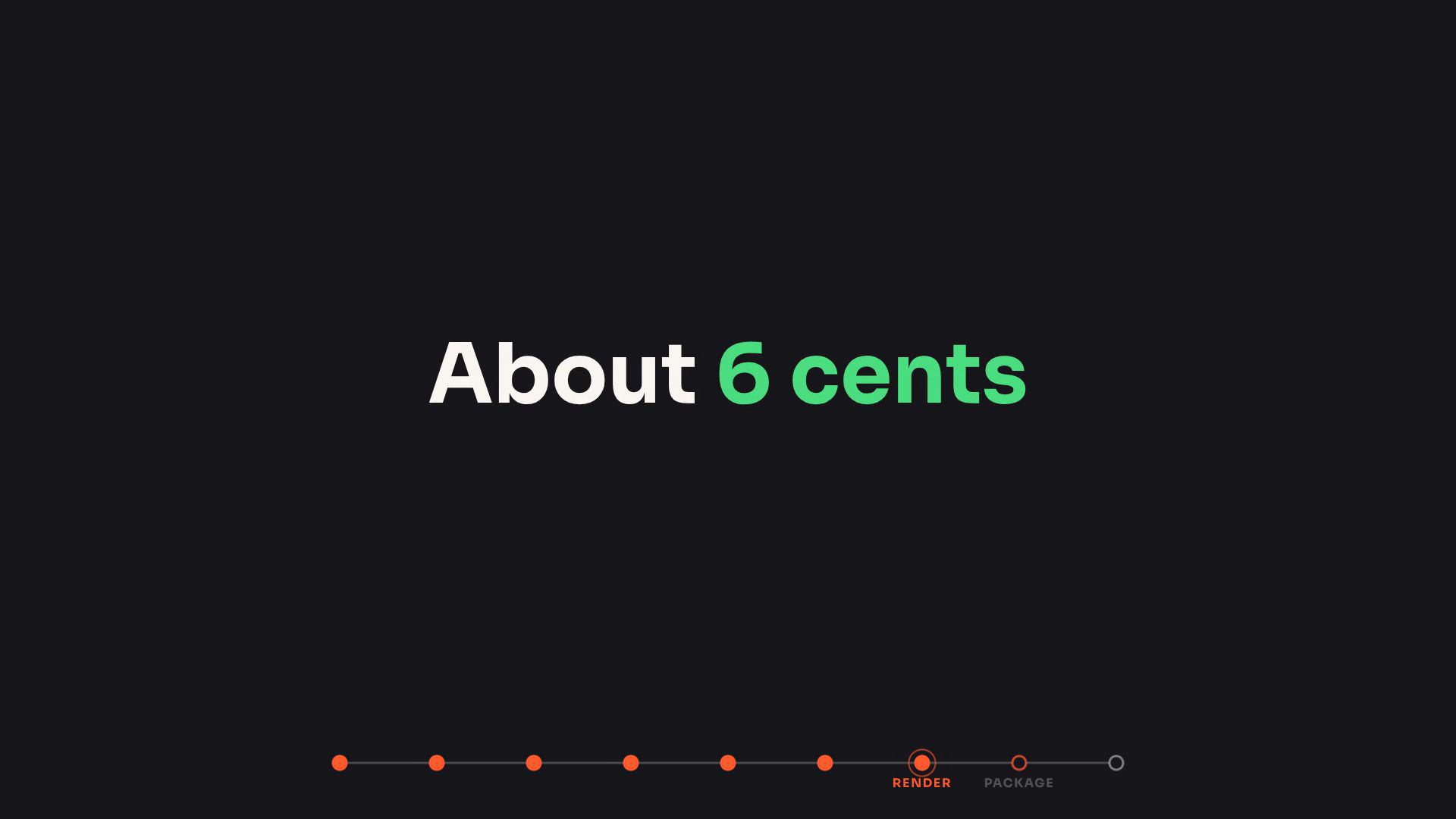
About 30 seconds and about 6 cents per finished video, running on rented cloud computers only for the seconds the render takes. Compare that against the 2 patterns everywhere else: the $10,000+ agency project, or the AI video SaaS that meters you by the minute and holds your projects on their servers.
This is the same rent-versus-own math as everything else in your stack. The workflow's files live in my folders. The animation components are code I keep. Every video makes the next one cheaper because the library compounds. A metered platform inverts that: every video costs the same forever, and the library belongs to the landlord.
My research stage runs on vidIQ, which is the 1 subscription in the line, and worth it because it's the stage that decides whether anyone wants the video at all. My link if you want it (affiliate link): vidiq.com/buildmarketclose.
How Do You Start Your Own Line?
Start with 1 video, not a system. (And once the structure matures, entire jobs run while you're out: AI content automation with real receipts is what that looks like 41 days in.) Research it before you write a word. Write the script and make yourself approve it before anything gets built. Record it in 1 take and hand everything after that to the machine. You'll have a crude version of all 9 stages by the end of your first video, and the line gets smarter every run after that.
The methodology under my whole line is Jake Van Clief's ICM folder system. The full credit is his; I just run it on content. His community is where it lives (affiliate link): Jake's Skool. And the free package version of this workflow, with the copy-paste prompts to build your own line, is in my community at buildmarketclose.com.