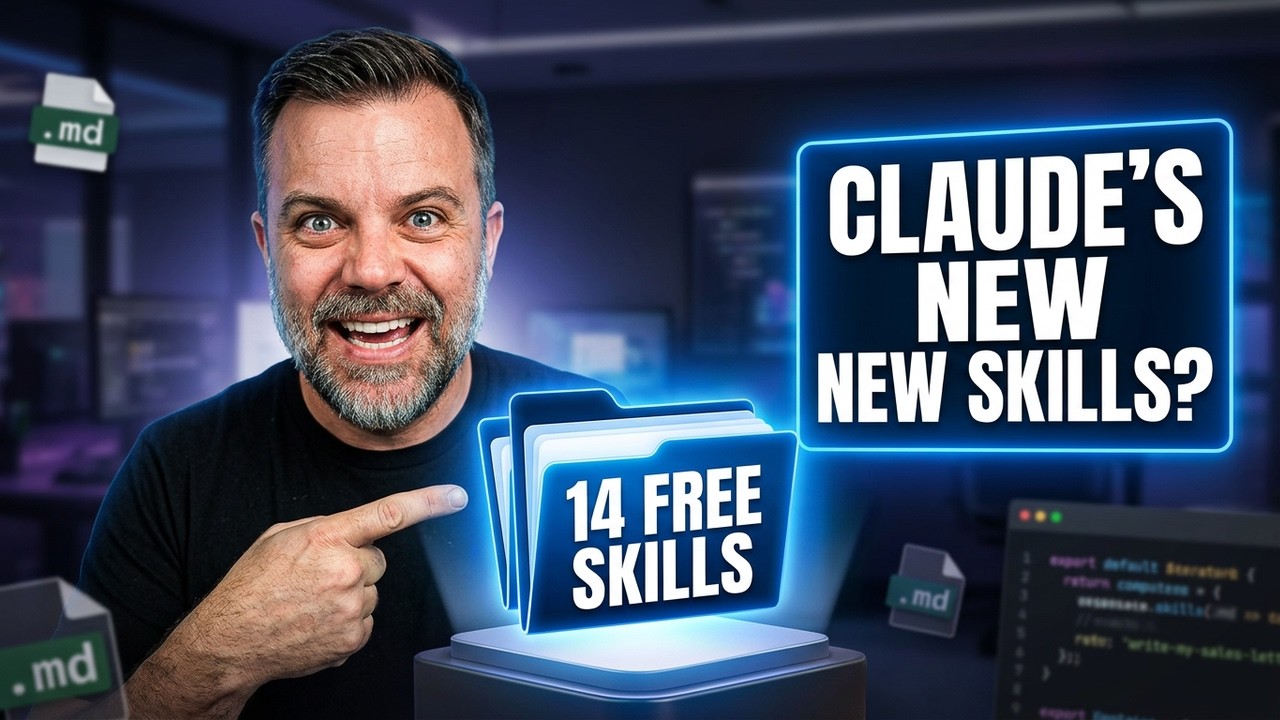
Claude Code skills for a small business are a folder with 1 text file in it, and you can make 1 in about 2 minutes without writing code. Anthropic just shipped 2 features around them for the big plans. Smart reports, which watch a team and find the work it keeps repeating. Shared skills, where 1 person builds a skill and hands it to the room. Both live on Team and Enterprise plans. I have been doing both for months with a folder, and the 14 skills I run my business on are free under the video.
What Did Anthropic Actually Ship?
2 things, and neither has a button a small business will ever see.
Smart reports launched September 10, 2026, in beta, on Claude Enterprise plans. The report watches how a team uses Claude and what Claude costs. The report shows where sessions run into friction. The report flags which repeated patterns are worth packaging as shared skills. Each card hands you a prompt to set the skill up.
Org wide skill sharing is a Team and Enterprise feature. 1 person publishes a skill to the directory. Everyone can install that skill. The skill is view only. When the owner saves a new version, everyone gets the update at next use.
Read those 2 again with a small business hat on. The report finds what you keep re-explaining. The sharing puts the same skill on your teammate's computer. That is the entire pitch, and both of those jobs are a folder.
What Is a Claude Code Skill, Really?
A folder. On your computer. The skill starts with a folder called dot claude. Inside sits a folder called skills. Inside that is 1 folder per job, named for the job. Inside each of those is 1 text file. That file is the skill.
The top of the file says when to fire. The top holds the name and the words you would say when you want the job done. Under that is how you do the job. The steps. The rules. The taste. Written once. Claude Code reads the file and does it your way every time. You never re-explain it again.
Shared skills, the Enterprise feature, is that same folder sitting on the other person's computer. Copy the folder, paste the folder, done.
Smart reports, the other Enterprise feature, finds the work you keep repeating. You already know what you keep repeating. It is the thing you typed into Claude 5 times this week. Write it in the file and the repeating stops.
I posted mine in my free community on July 26, and wrote this on the post: I had to re-explain stuff to Claude every new project, and I have a bunch. That is the exact problem the report was built to find, 6 weeks later. I did not need a report. I wrote it down once, and now I go from idea, to sales page, to closing deals in a day, not weeks.
How Do You Make a Skill Without Writing Code?
5 steps, and you do not write a single file yourself.
- Open Claude Code and tell it the job you keep re-explaining.
- Tell it to make a skill for that job, then tell it how you do it, the way you would tell a new hire.
- It builds the folder and the file for you and puts them in the right place. I make all of mine global, so every project on the machine gets them.
- Read the top of the file and fix the words to what you would actually say. That is what makes the skill fire.
- Restart Claude Code, then ask for the job like normal. The skill fires on its own.
2 minutes, and that job is written down for good.
The 14 Claude Code Skills I Run My Business On
These are the 14, in the order a business needs them. Every 1 is a text file I wrote once.
- Niche research, so that you learn if a niche can afford your thing, their pains, their language, marketing angles, to build out a well positioned offer
- Headline copywriting, so that you get the headline and the hero that stop the scroll (the most important element of a page)
- Direct sales copy, so that you get a direct-letter style sales letter aimed at 1 reader that makes them feel understood
- Sales page builder, so that you get the full page in the order that converts (filesnfolders.com converts 1 in 4 cold readers into a subscriber)
- Profit calculator, so that your prospect runs their own numbers because nobody argues with their own math (the calculator on this site for an example)
- Paid traffic landing page, so that you get a 1 decision page that matches the ad, maximizing ad spend and conversions
- Exit pop, so that you catch the visitor on the way out with a "mini-sales page" with a new positioned free thing (this site for an example)
- Call funnel, so that your site traffic turns into booked calls on 1 calendar
- Relationship sequence, so that you get the 10+ emails that train a subscriber on opening your emails & learning about you (subscribe to see mine)
- VSL copywriting, so that you get a video sales letter written 1 slide at a time
- Video script, so that you get a short teaching video written the same way (the video above was written with it)
- SEO writer, so that you get a 1 keyword targeted blog post that ranks & follows best practices
- AEO blog writer, so that you get the post that Google AI and ChatGPT quote back
- Code audit, so that you find the bugs, the slow spots, and the SEO holes on any site you ship
They hand off to each other. A skill fires when your words match its file. Some days Claude decides wrong. That is what Claude Code hooks for small business fix. The rule runs whether Claude remembers the rule or not. The niche research writes a handoff the sales letter reads. The letter feeds the page. The page feeds the sequence. Nothing gets re-explained between them because the folder is built on the Interpretable Context Methodology. The skills folder is the same shape as the Claude Code second brain from the video before this 1.
Why This Is an Ownership Question
An Enterprise seat rents you the report and the sharing. When the seat goes away, the skills go with the seat.
A folder on your machine is yours. Text files, backed up, named after the job. Same as every YouTube to Skool classroom lesson I ship. If the plan names change tomorrow, the folder still fires. The skill you share with a teammate is a folder you copied, not a directory entry somebody else controls. If you ever wondered whether Claude Cowork or Claude Code is the 1 for this, it is Claude Code, because it walks the folder and reads the file.
That is the same reason I run my CRM on my own stack instead of renting a seat in somebody else's. The tool can change its plans. The files do not.
Do It Tonight
All 14 skills are free on the video's page. Put your email in and they come to you, with the install steps. Then tell Claude Code your business, ask it for a sales letter, and watch the first 1 fire.
Want the software side of this? The CRM, the pages and the sequences run on a stack you hold the title to. That is buildmarketclose.com. Free.
The folder method is Jake Van Clief's and David McDermott's Interpretable Context Methodology. The 14 skills, the 5 steps, and the free version of shared skills and smart reports are mine.