Claude Code hooks for a small business are a check that runs on its own at a moment you pick, and you set 1 up without writing a single line of code. A skill fires when your words match its file. A hook fires no matter what. I run 3 on my business. You can watch 1 fire live in my terminal in the video. All 3 are free under the video, wired and ready.
What Is a Claude Code Hook, in Plain Words?
A check that runs on its own at a moment you pick.
You may hear or read something say "user-defined shell commands that execute automatically at specific points in Claude Code's lifecycle." That is Anthropic's line, off their own page. All it really means is the sentence above.
Every guide on page 1 for this search says hooks are built by developers for developers, and points a business owner at Zapier instead. I can't write a single line of code myself. The 3 hooks below run on my business, and Claude Code wrote every file.
3 days before the video I fixed a 43 copy Claude Code mess for a member of my community. He asked me if he was good to use the folder system now. I told him yes, and the next thing would be to dial it in even further with hooks. So the video is hooks.
Why Is a Skill Not Enough?
Because Claude decides whether your words match, and some days Claude decides wrong.
In the video before this 1 you learned that a Claude Code skill is a folder with 1 text file inside. That file tells Claude when to fire and how you do the job. Claude reads it when the words you type match the top of the file.
That is exactly what happened the day I typed "am I crazy?!" into a session. Claude read my rule and then answered the question by hand instead of firing the audit skill.
A hook sits right beside the skills in the same dot Claude folder. It is 1 line in the settings file that says at this moment, run this check. The check is 1 small text file that Claude Code writes for you.
The moment I picked for my skill trigger is the moment I hit enter on anything I type. The trigger reads my words before Claude even gets a chance to see them, and names the skill that has to fire. Claude does not get to decide anymore. The hook already decided for Claude.
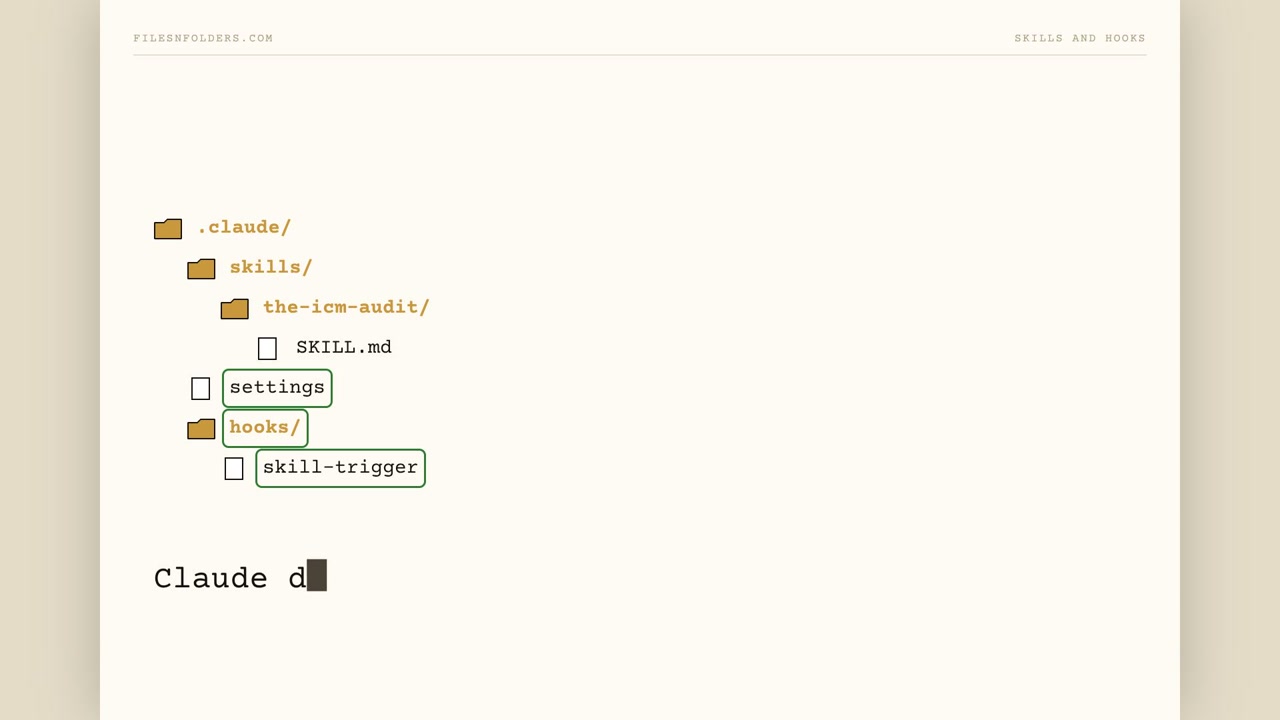
Skills suggest. Hooks enforce.
How Many Moments Can a Hook Fire At?
33, and most people only need 3 of them.
Anthropic's word for a moment is "event." An event is simply when the check runs. The full list is on the hooks page.
- When you type. That is where my skill trigger lives.
- When Claude stops talking and hands the keyboard back to you. That is where my price guard and my voice check live.
- Before Claude touches a file. That 1 is your next door.
Hooks work on every Claude Code plan. There is no Team seat or Enterprise stuff needed.
What Are the 3 Hooks I Run?
A skill trigger, a price guard, and a voice check. Every 1 fires whether Claude remembers my rule or not.
The skill trigger reads my words the moment I hit enter and names the skill that has to fire. You put your own trigger words in a text file, 1 line per rule.
The price guard runs every time Claude stops. It checks every payment link on every public page against the 1 list that I already signed. Because a wrong number is a typo, but a wrong link sends money the wrong place.
The voice check runs every time Claude stops. The voice check reads only the files I touched in the last 20 minutes. The check looks for my banned words, a spelled out number, developer talk and a missing close. When a file is clean it prints nothing. No news is good news.
The first version of that check read every video folder I own on every single turn. It printed the same 14 problems over and over until the list was 1,937 lines long. I turned it off, because a warning that never goes away is not a warning. 2 days later it came back with 1 new rule. Say each problem 1 time, then never bring it up again. That is the version that stayed, and that is the version you get.
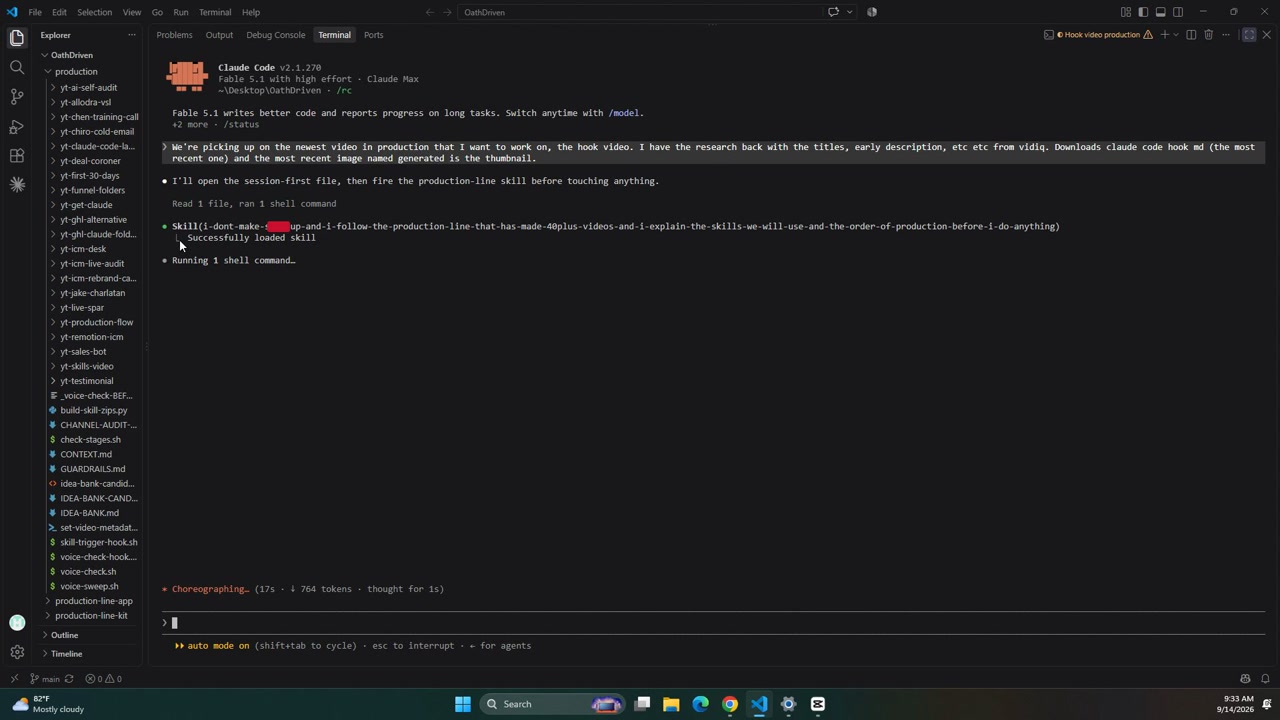
That still is from the live part of the video. I asked for a job the way I always do, and the trigger named the skill before Claude got to decide. I never typed the skill's name.
How Do You Make Your First Hook Without Code?
5 steps. Claude Code writes the file. You write the rule.
- Pick the 1 rule you keep repeating and Claude keeps forgetting.
- Tell Claude Code to check for that rule every time Claude stops. Tell it to say the finding once and stay quiet when the file is clean.
- Claude Code writes the settings line and the check file for you. You type nothing.
- Read the file back in plain words. If anything is wrong, fix it with Claude right there.
- Restart Claude Code and ask for the job the way you always do.
If the check runs without you asking, you have just created your first hook. Every rule you keep repeating, you can now create a hook for it the same way.
Why This Is an Ownership Question
A hook is a text file in a folder on your machine.
It is not a feature on a plan. It is not a setting somebody else can move. The rule, the check and the moment the hook fires are yours. They sit in files you can read, backed up next to the Claude Code second brain they protect. If the plan names change tomorrow, the folder still fires.
That is the same reason I run my CRM on my own stack instead of renting a seat in somebody else's. Rented rules are suggestions. Owned rules enforce.
Do It Tonight
All 3 hooks are free on the video's page. Put your email in and the 3 hooks come to you with 1 paste. That paste has Claude Code set them up. Then Claude Code asks you for your trigger words, your banned words and your approved links, 1 question at a time.
Want the software side of this? The CRM, the pages and the sequences run on a stack you hold the title to. That is buildmarketclose.com. Free.
The folder method is Jake Van Clief's and David McDermott's Interpretable Context Methodology. The 3 hooks, the 5 steps, and the way I use hooks to enforce my rules are mine.