Rent the commodity, own the core. That's the honest answer to SaaS rent versus own, and it's the one nobody selling you a subscription will give you. Renting software makes sense for tools you use lightly or that are pure commodities. Owning makes sense for the one system your business actually runs on: your CRM, your customer data, your automations, the place where costs scale with your growth and losing access means losing the asset itself.
Most companies rent everything, by default, without ever asking which side of that line a given tool belongs on. Here's the data, an honest framework, and the metaphor that makes the whole thing click.
The problem: you rent more than you think, and it keeps costing more
The average company now runs more than 100 SaaS apps, all rented, all recurring. And the bill climbs even when you add nothing. Per Zylo's 2026 SaaS Management Index, software spend rose 8% year over year even as app portfolios stayed flat, so companies paid more for the same stack. In the same research, 79% of IT leaders hit a price increase at renewal, and nearly half of all licenses go unused while the invoice arrives every month regardless.
That's the shape of renting: a cost that only moves one direction, on software you'll never own, that you're often not even fully using. Read the renewal-hike number again. Four out of five got the landlord's rent-increase letter.
The metaphor: you're a tenant, and the rent has a growth clause
Here's the frame that reorganizes the whole decision. Your software stack is digital real estate, and most of it you rent. The platform is the landlord. Your monthly bill is rent. And the ugliest clause in the lease is what we call the growth tax: per-seat, per-contact, and usage-based pricing that charges you more every time your business grows. Add a client, hire a rep, grow your list, and the rent goes up, for the same software.
Stop paying and it all vanishes. Your data, your automations, your workflows. You never held title. That's not a scare story, it's the standard SaaS data policy: access ends when payment does. You can pour ten years into a platform and own exactly what you started with, which is nothing.
There's an old real-estate word for the opposite of that: allodial. Held in absolute ownership, owing rent to no landlord. That's the standard worth holding your core systems to.
The honest framework: when to rent, when to own
Owning is not always right, and any page that tells you otherwise is sloganeering. Here's the real tradeoff:
| Rent (SaaS) when… | Own when… |
|---|---|
| The tool is a commodity (payroll, expense, email) | It's a core system you'll run for years |
| Usage is light or bursty | Costs scale with your growth (the growth tax) |
| You want zero maintenance and vendor-shipped updates | The data is something you can't afford to lose access to |
| You need time-to-value now, over perfect fit | You'd otherwise be locked in with no clean exit |
| You won't run it five years | It holds your competitive edge |
Rent your accounting software. Nobody wins by owning a payroll commodity. But the system that holds your customers, your pipeline, and your automations? That's the one worth owning, because it's the one you'll run for a decade and the one whose rent has the nastiest growth clause.
The math: where owning crosses over
The build-versus-buy literature is consistent: for a core business system, the total cost of owning drops below cumulative rent somewhere between year three and year five. Run a core system for five years and comparable SaaS often costs about the same as owning it outright, with one difference: at the end of the rental you have a renewal notice, and at the end of ownership you have an asset.
The honest caveat: owning isn't free. Maintenance is more than half the lifecycle cost of any owned system. Which is exactly why "own it yourself from scratch" isn't the pitch. The sensible version is to own the asset without personally carrying the engineering and maintenance burden, the middle path between renting forever and building a software company you didn't mean to start.
What owning actually looks like
Owning your core software doesn't mean a year-long custom build or a developer on payroll. It means buying a CRM you hold title to: the code is yours, it runs on infrastructure you sign up for on your own accounts, and the AI is wired straight to the providers instead of through a platform's markup. No per-seat meter. No renewal-hike letter. No day where the rent stops and your business locks you out.
Here's what the "own" column actually bills. That's 12 projects running, 3 days left in the cycle, $4.23 of a $20 included credit used, and $0 in on-demand charges.
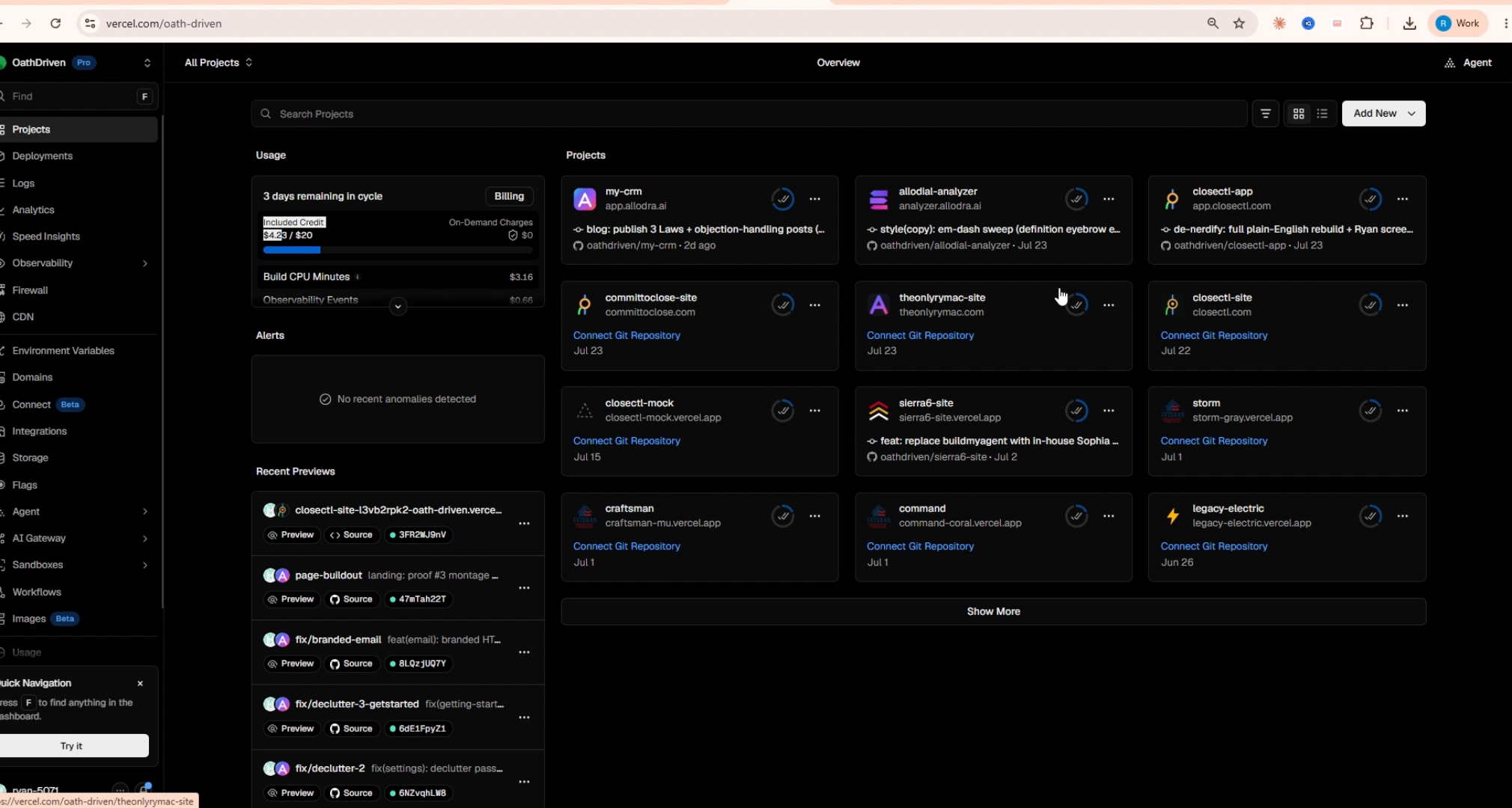
That's the Allodra model, and it's the "own" column of the framework made real for the one system most worth owning. We even broke down what a rented platform like GoHighLevel really costs over ten years, so you can see the growth tax in actual dollars.
If you resell what you build, ownership shows up on the other side of the ledger as well. Working out how much to charge for AI automation means solving for a price floor, and you can only hold a floor when nobody else is metering the cost underneath it.
The bottom line
SaaS rent versus own isn't a slogan fight, it's a line you draw tool by tool. Rent the commodities. Own the core, the system your business runs on, whose costs rise with your success and whose data you can't afford to lose. The average company rents all of it and pays a little more every year for the privilege.
Run your own core stack through the cost analyzer and find the ten-year number. Then decide which of your tools are commodities worth renting, and which one you should finally own.