Charge a percentage of your client's monthly net profit, not a number that feels good. Under 10% of their net is a stretch they can say yes to. Between 10% and 20% is hard and you have to prove the return before you say the price. Past 30% you are done, no matter how good the offer is. Everything below is how you find that percentage, and how you find the floor underneath it that you can never go below.
I ran the whole method on camera, start to finish, on a real niche I was actually pricing. Watch it, then read the short version.
How much should you charge for AI automation?
Between 6% and 20% of the client's monthly net profit, and the sweet spot is right around 10%.
Every pricing guide you will find hands you a range instead. The 2026 AI agency pricing benchmarks put automation setup at $2,500 to $15,000 and ongoing work at $500 to $5,000 a month. Those numbers are not wrong, they are just useless on their own, because they are not attached to the person paying them.
Here is the same price tested against a real operator. The median mobile diesel repair shop nets $4,875 a month. Not revenue. What is left.
| Monthly price | % of their net profit | Verdict |
|---|---|---|
| $297 | 6.1% | Edge of affordable |
| $497 | 10.2% | Works. This is the entry price |
| $797 | 16.3% | Needs payback inside the first cycle |
| $997 | 20.5% | Prove the ROI before you say it |
| $1,500 | 30.8% | Dead on arrival |
| $2,000 | 41.0% | Top 25% of the market only |
$1,500 a month is the number the gurus tell you to charge. Against a real median operator it is almost a third of everything he takes home. No owner alive pays a third of his profit for one tool. The research did not just kill that price, it handed me the right one.
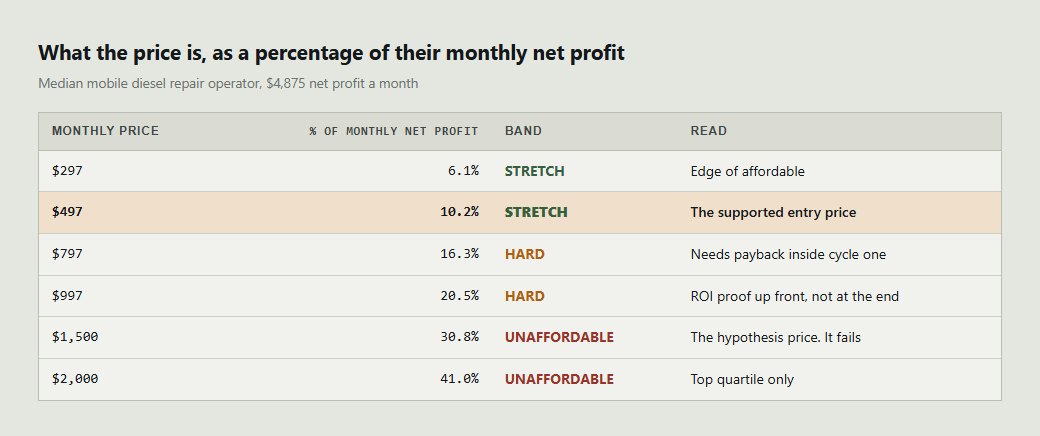
That table is straight out of the research I ran on the niche. Same method, any trade.
What does it actually cost you to deliver?
Pull the real bill, not an estimate. For a voice agent running about 440 minutes a month, mine looks like this:
- Voice: 440 minutes at $0.10 a minute, so $44.
- Payments: Stripe takes 2.9% plus 30 cents per transaction.
- Platform: $0 marginal, because I own the code instead of renting a seat.
Now the same product delivered the other way, on a rented all-in-one platform: roughly $97 a month for the platform plus $0.25 a minute for voice, which is $110. That is $207 a month to rent what costs me $44 to own. Almost 5 times, for an identical result on the client's end.
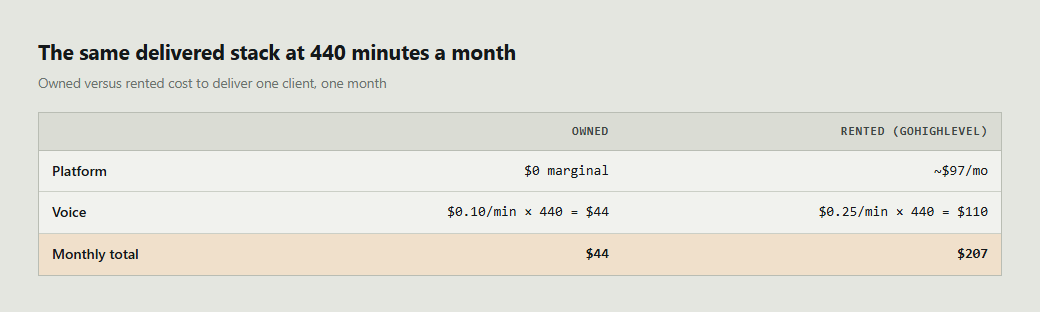
That gap is either your margin or somebody else's. There is no third option.
If you want the per-minute breakdown of where voice pricing actually comes from, I took it apart in the post on what an AI voice agent really costs. The chat side has the same gap between cost and price, and it is wider: I ran the numbers on ai chatbot development services and the markup there is measured in hundreds of times, not percentages.
What is your price floor?
Your floor is the lowest price where you still hit your target margin after every cost. Mine is 65% net, which is what I have run software and automation businesses at for 15 years.
Solve for the price P where 65% survives:
P - 0.029P - $0.30 - $44  >=  0.65P
0.321P >= $44.30
P >= $138
$138 a month. That is the floor on this example. I will never sell there. I still have to know it, because nobody negotiates well from a number they cannot defend.
Knowing your floor is also the only thing that lets you be honest when you are new. You can say "I am charging everyone else $497, but I want testimonials, so I will do it for $150, which is my break-even" and mean it. Say that without knowing your floor and you are just discounting and hoping.
Why a rented stack does not really have a floor
Because on a rented stack your cost is metered, and a metered cost moves with your client's usage.
This is the part the pricing guides skip. They will tell you to add 30% on top of your hours and your tool subscriptions and call that a floor. That works right up until a client has a busy month. Their volume goes up, your platform bill goes up, and the margin you priced against quietly disappears. You did not set that price. Your landlord did.
Look at the numbers again. At 440 minutes the rented version costs $207. At 900 minutes it costs a lot more, and every dollar of that comes out of the same $497 you already quoted. You cannot hold a 65% margin on a stack somebody else meters. Your floor is not a floor, it is a number your vendor is allowed to move.
That is the whole reason Allodra exists. You buy the platform once and own the license, so there is no monthly rent and no growth tax when you win. It runs on free enterprise tiers from Google Cloud, Cloudflare, GitHub and Vercel, and the AI is wired straight to the providers, so you pay what the model actually costs with nobody's markup stapled on. Charter access starts at $900 one time.
The pricing lesson stands on its own either way. But a defensible price needs a cost you control, and rent is not a cost you control. I laid out the full case in renting software versus owning it, and the real all-in number on the rented side is in the true cost of GoHighLevel.
How do you know what they can afford?
Find their median monthly net profit and make your price a percentage of it. That is the entire test.
Get there in 3 steps:
- Median annual revenue. Industry surveys, IBISWorld free stat pages, and Census County Business Patterns will get you close for almost any trade.
- Median net margin. Most trades publish this somewhere. For mobile diesel it is 11% to 15%.
- Divide by 12. $450,000 at 13% is $4,875 a month.
Two rules that will keep you from embarrassing yourself.
Judge against the median, never the winner. The top 25% of that trade nets $21,000 to $33,000 a month, where your $1,997 is only 6% and an easy yes. Price off that guy and you have built an offer for the slice of the market that needs you least.
Watch for owners who do not pay themselves. In this trade, 31% of shop owners take no salary, which means a lot of quoted margins are really SDE, not net profit. When a solo operator says he nets 15% on $200,000, he means $30,000 is his household income. Never tell a small operator he has margin to work with. He does not, and he will know instantly that you have never run one.
What is the rule of 100?
It is a 10 second way to work out what a lead costs in any market, in your head, live on a call.
Take the cost per click and multiply it by 100. That is what 100 clicks costs. Then split it by conversion rate.
$5 a click x 100 clicks    = $500 for 100 clicks
World class, 10% convert   = 10 leads    -> $50 a lead
Average, 3.75% convert     = 3.75 leads  -> $133.33 a lead
Always round the click price down. If your conservative number still lands, you never have to defend it.
Now you can say the thing that actually works: "miss 1 call and you just threw away a $133 lead you already paid for." You did not tell them anything. You got them to do the math with you.
Never argue about your price
Once the research is done you stop defending numbers, because you are not the one making the argument. Their own numbers are.
Break even in their units, not yours. My price was $497. Their average job throws off $336 in gross profit. So it takes 1.5 jobs a month to pay for the whole thing, and the median operator runs 3 jobs a day. Nobody feels $497. Everybody feels half a day of normal work.
Anchor against the leak, not against competitors. Scoring that niche on speed to lead, follow up and message match put about $4,491 a month on the floor. Against a $497 price that is 9 times their money back. When the gap is that wide the price stops being the conversation.
Price is not a number you pick. It is a number you earn by doing the work, and the work is the only thing that makes it defensible.
If you want to see what the rented side of your own stack is costing you before you set a price on top of it, run your numbers through the analyzer.